
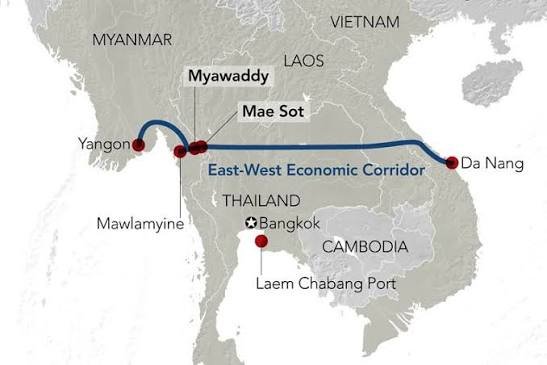
On August 7, 2026, Thailand's Prime Minister Anutin Charnvirakul hosted Myanmar junta leader Min Aung Hlaing in Bangkok, where the two nations established an ambitious bilateral trade target of 12 billion dollars, up from the current 7.4 billion dollars. The critical centerpiece of this diplomatic push was the high-profile reopening of the Second Thailand-Myanmar Friendship Bridge. Connecting Mae Sot in Thailand to Myawaddy in Myanmar, this vital crossing had been unilaterally shut down by the Myanmar junta for nine months before finally resuming operations. This single bridge is now expected to carry the vast majority of the cross-border transit required to nearly double their bilateral trade by 2032.
However, this economic lifeline sits directly adjacent to one of Southeast Asia's most notorious hub networks for transnational crime. The town of Myawaddy hosts infamous cyber-scam compounds—such as KK Park—where thousands of trafficked workers from dozens of countries are held against their will and forced to execute global online fraud operations.
Despite heavy-handed diplomatic rhetoric and targeted law enforcement actions, dismantling these highly lucrative criminal networks has proven nearly impossible due to their extreme adaptability:
This dangerous proximity outlines a high-stakes balancing act for both governments. Thailand desperately needs the friendship bridge to stay open, as legitimate cross-border commerce underpins thousands of jobs and local businesses. Simultaneously, the cash-strapped Myanmar junta urgently requires the influx of trade revenue after severe import restrictions cut two-way commerce nearly in half.
The core geopolitical dilemma is that the exact same roads, border checkpoints, and simplified customs procedures designed to accelerate legal trade are simultaneously exploited by sophisticated scam syndicates and drug traffickers. While Bangkok and Naypyidaw have pledged closer intelligence sharing to combat cross-border syndicates, this commitment will only hold value if the expansion of legitimate trade does not inadvertently provide deeper, more integrated logistical cover for illicit networks to scale up their operations alongside it.