
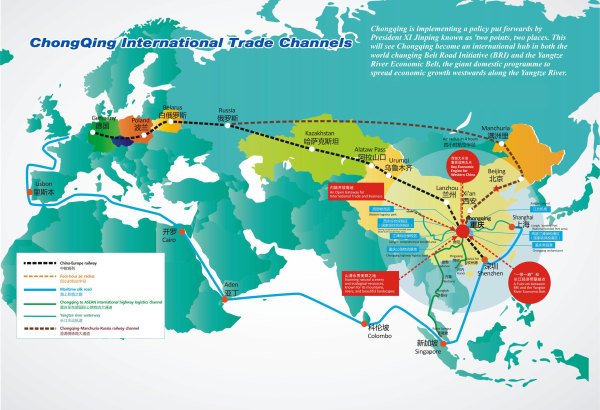
On July 30, nearly 200 government, business, and finance representatives from China and Malaysia met in Kuala Lumpur for the 2026 Land Sea Economic Forum, focusing on how artificial intelligence can be integrated into the New International Land Sea Trade Corridor (ILSTC). The corridor itself is not new. Since 2017, it has connected Chongqing in western China through Guangxi’s Beibu Gulf ports to Singapore and onward across ASEAN. What is changing is the scale of the network and the technology layer being added to it.
The numbers show how quickly the corridor has developed. Container shipments increased from just 3,382 containers in 2017 to 1.43 million in 2025, while the network now connects 584 ports across 127 countries. Digital customs systems have also significantly reduced delays at Guangxi’s ports.
At the Kuala Lumpur forum, Malaysian officials said transit times between western China and Southeast Asian ports have fallen from weeks to just days. AI is increasingly being used to improve logistics routing, customs compliance, cargo tracking, and even capital allocation, building a digital layer on top of the railways, roads, and ports already connecting the region.
The expansion could make regional supply chains faster and more resilient, particularly for manufacturers that depend on predictable deliveries. Better visibility across transportation networks can help companies identify delays earlier, optimize routes, and manage inventories more efficiently.
However, Malaysian business leaders also highlighted an important limitation: technology does not automatically deliver the same benefits in every market. A manufacturing federation official emphasized AI’s potential to improve supply-chain visibility and resilience, while a University of Malaya professor argued that AI creates meaningful value only when it is adapted to local conditions rather than simply copied from Chinese systems.
This creates an important question for the future of the corridor. Large ports and major manufacturing hubs may benefit first from advanced AI systems, while smaller ASEAN economies could struggle to access the same technology, infrastructure, and investment.
The success of the ILSTC will therefore depend not only on how quickly China and ASEAN expand physical infrastructure, but also on how effectively the technology layer can be adapted across different markets. If AI integration spreads successfully, the corridor could become a faster and more connected trade network linking China with Southeast Asia.
China and ASEAN are adding AI to a rapidly expanding trade corridor, promising faster logistics while raising questions about how evenly smaller economies will benefit.
AI is transforming the China-ASEAN trade corridor, making regional supply chains faster, smarter, and more connected.